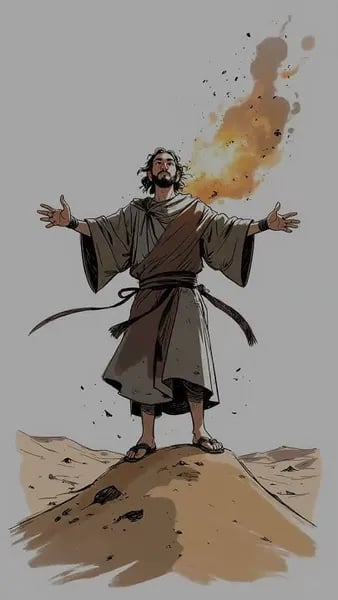
I remember a rainy afternoon when I first read about a farmer who walked into the desert and never looked back. That farmer was St. Anthony the Great. In this short piece I lean into my own surprise—how someone born into comfort (I like to remind myself I am not him) chose radical simplicity. I’ll walk you through why that choice still matters, how silence and struggle shaped him, and how I’ve tried (and failed, and tried again) to borrow a little of his courage.
1 — The Moment He Let Go: Selling Wealth to Seek God
I picture St. Anthony the Great in the 3rd century, surrounded by wealth and noise, inheriting about 300 acres—then choosing, quietly, to let it go. He Sold Possessions Poor, supported the needy, and even placed his sister in steady monastic care. It feels like the Rich Young Man story made real: not a stunt, but a new direction.
“He gave everything away… not to escape the world, but to seek God alone in silence, prayer, and struggle.”
I once donated my “extra” bookshelf and felt oddly lighter. This hinge-moment made him the Father of Monasticism. What one thing would I give away to hear God more clearly?
2 — Desert Monasticism: Solitude as a Practice
I’m fascinated by how sand, wind, and emptiness became a school for Desert Monasticism. In the 3rd century, Anthony “gave everything away… to seek God alone in silence, prayer, and struggle.” He didn’t run from people; he ran toward God, and “Anthony discovered inner freedom.”
Though he chose a Solitary Life, his silence seeded a movement—cells spread across the desert. That’s why he’s called the Father of Monasticism: he taught humility, silence, and wise discernment.
On my own short retreat, two quiet hours taught me more than a week of noisy prayer.
10 minutes alone daily
one fixed silent hour
digital fasting
micro-desert day: no screens, 2 silent hours, 1 act of charity
3 — Spiritual Discipline and Ascetical Life
I practice small Spiritual Discipline: early rising, focused prayer, and fasting—nothing like Anthony, but honest. His Ascetical Life was not to escape the world, but to seek God alone and find inner freedom.
“Not to escape the world, but to seek God alone in silence, prayer, and struggle.”
For me, ascetical life means brief practices that train the heart for greater love and clear sight. In Athanasius and monastic writings, Anthony faced Spiritual Warfare, resisting demons through prayer and the Cross, learning wise discernment.
Silence (10 minutes)
Continuous Prayers through the day
Humility: let someone else go first
Pick one for 30 days and journal what shifts inside.
4 — Inner Freedom: What He Found in Silence
I confess: I often look outward for peace. Anthony points me inward, into disciplined silence. Inner freedom is letting go of wealth, noise, and the need for approval.
“Anthony discovered inner freedom.”
On a quiet morning walk, I left my phone behind. In the stillness I saw a petty worry—wanting to look “right” to others—and I released it with one simple prayer.
That kind of freedom made Anthony a steady guide, a spiritual anchor.
“His life inspired generations of monks and the church.”
Five Minutes for Spiritual Growth
Sit still.
Breathe slowly.
Whisper:
“Lord, free my heart.”
This is a Virtuous Life, a Beautiful Life.
5 — Teachings of Anthony: From Humility to Discrimination
In the Teachings of Anthony, I learn inner freedom by using discrimination as my daily filter: what leads me to God, and what pulls me away. In monastic wisdom, discrimination is the mother of virtues, helping me choose lasting good over quick pleasure on the road to Spiritual Perfection.
Anthony also defended the Orthodox Faith against Arian and Manichaean errors, and his example inspired generations, preserved by the Church Fathers, especially St. Athanasius.
humility
silence
prayer
separation from noise
Read short lines from Life of Anthony.
humility
silence
prayer
watchfulness
mercy
simplicity
gratitude
“St. Anthony the Great, pray for us.”
6 — Practical Takeaways: How I Borrowed His Rhythm
I’ll be honest: I failed at a 40-day fast. So I built Spiritual Discipline in small, measurable steps.
“Sometimes we must step away from the noise to hear God clearly.”
Humility Silence: one quiet hour each day (5–20 minutes).
Weekly charity split: set aside a small, fixed amount.
Evening examen: 3 questions, 3 minutes.
My schedule: morning Continuous Prayers; midday brief silence; evening reflection.
Metrics: days of silence, acts of charity, minutes in prayer per week.
FAQ
Family life? Yes—practice micro-solitude: one locked-door minute, one quiet walk.
7 — Wild Cards: Strange Analogies and Hypothetical Scenarios
Imitation Saints, a Smartphone, and a Monastic Library
I picture Anthony with a phone: 1 prayer app, 0 social feeds. He’d step away from noise to hear God clearly, like he did in the desert. In my Monastic Library, I file this under Christian Monasticism for the digital age.
Analogy: the desert is an emptied inbox—both make me face what matters.
Hypothetical: could he found digital monastic cells? Yes: rhythm, discipline, and 1 hour weekly of micro-desert.
Creative exercise: write a 100-word desert prayer.
“Silence isn’t empty; it’s where God speaks.”
“St. Anthony the Great, pray for us.”
8 — Conclusion: Living the Beautiful Life, Small Acts at a Time
I close where I began: that rainy afternoon, and the farmer who walked into the desert. The Life of St. Anthony is an invitation, not a rule. This 3rd-century Egyptian monk (born ~251 AD) gave away wealth, chose desert solitude, practiced hard discipline, and found inner freedom—then inspired generations and shaped the church as the Father of Monasticism. My Spiritual Hero shows scalable steps: small renunciations and small silences can remake a modern soul.
Try this: seven days of deliberate silence, and one charitable act—then tell me in the comments (I’ll read them). Renunciation grows generosity; solitude becomes service. I will fail sometimes, but I will begin again.
“St. Anthony the Great, pray for us.”